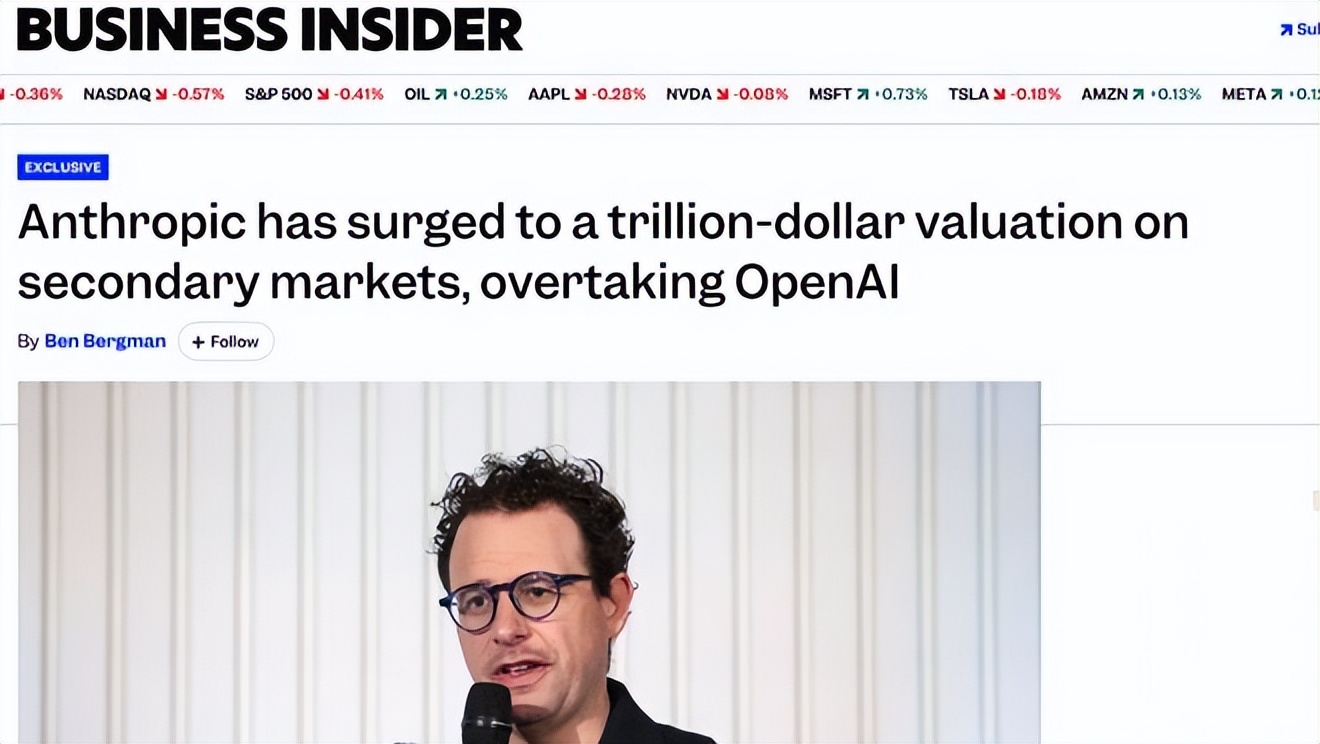
Anthropic Surpasses OpenAI with $1.2 Trillion Valuation
Anthropic’s valuation has reached $1.2 trillion, surpassing OpenAI for the first time on the private secondary market Forge Global. This rapid rise from a $1 billion ARR in early 2025 to $30 billion by April 2026—30 times growth in just 15 months—is largely attributed to Claude Code. With Elon Musk’s backing of 220,000 top-tier GPUs and a $200 billion long-term contract with Google, Anthropic is reshaping the global AI landscape.

What Does $1.2 Trillion Mean?
To put $1.2 trillion into perspective:
- It is more than half of Nvidia’s peak market value in 2024.
- It is roughly equivalent to the combined market value of Tencent, Alibaba, and Baidu.
- It marks the first time an AI company has surpassed OpenAI in valuation.
Anthropic achieved this valuation in under five years, while OpenAI took seven years to reach a similar level. Importantly, this valuation reflects genuine transaction prices in the private market, indicating the true willingness of institutional investors to pay.
The Secret Behind the 30x Growth
In early 2025, Anthropic’s ARR was $1 billion, which skyrocketed to $30 billion by April 2026. This 30-fold increase in just 15 months is unprecedented in enterprise software history. For context, Salesforce took nearly ten years to achieve a similar growth rate, and Snowflake took five years. The driving force behind this growth is Claude Code.
If you are a programmer, you have likely used or tried Claude Code. Its rapid adoption—from command line to IDE, and from code completion to full-process agents—has transformed many developers from casual users to reliant ones. Recent reports indicate that Anthropic’s ARR has exceeded $44 billion, with Claude Code contributing significantly to this figure. Companies are willing to pay for AI programming tools as they directly save labor costs, providing a clear ROI.
Musk’s GPUs and Google’s $200 Billion Contract
Two major backers have propelled Anthropic to its current status:
- Elon Musk’s 220,000 top-tier GPUs. While Musk is in a legal battle with OpenAI, he has provided these GPUs to Anthropic, illustrating that in the realm of AI computing power, the enemy of my enemy is my friend.
- Google’s $200 billion long-term contract. Google is one of Anthropic’s largest strategic investors, ensuring a steady supply of cloud services, thus alleviating concerns about computational resources.
The combination of 220,000 GPUs and a $200 billion contract forms Anthropic’s “computational moat.” In the AI industry, computational power is akin to ammunition; those with more can train larger models, serve more users, and iterate faster.
How OpenAI’s Throne Was Overturned
Frankly, I am not surprised by this shift. OpenAI’s biggest issue over the past three years has not been technological shortcomings but rather strategic inconsistency. From non-profit to profit, from open to closed, and from GPT to various product lines, OpenAI has spread its focus too thin. In contrast, Anthropic has remained focused from day one: to create the safest AI and the best programming assistant.
The benefits of this focus are clear: concentrating all resources in one direction leads to a superior product experience compared to a company that tries to do everything. Claude Code’s dominance in the AI programming market stems not from superior models but from Anthropic’s meticulous product refinement in programming scenarios.
Real Impact on Developers
As a programmer who uses both Claude Code and GPT, my observations are:
- Anthropic’s rise is beneficial. Competition drives evolution; having OpenAI as the sole player is not advantageous for anyone.
- More diverse AI programming tools. The choice is no longer just between “GPT or Claude” but involves using different tools for different scenarios.
- A potential price war may be on the horizon. OpenAI has started subsidizing enterprise users, and Anthropic will likely respond, leading to short-term benefits for developers.
- Don’t let valuation dictate your technical choices. A $1.2 trillion valuation has no direct impact on daily development; the focus should be on usability, not on whose valuation is higher.
Personal Perspective
Anthropic’s ascendance is not merely a story of “who is stronger” but rather a tale of focus defeating dispersion. OpenAI aims to do everything—ChatGPT, DALL-E, Sora, Codex, search, etc.—while Anthropic focuses on one goal: making Claude the best AI assistant, especially in programming.
In the startup phase, focus is a survival strategy. At the trillion-dollar valuation stage, focus becomes a moat. Anthropic has demonstrated that even if you concentrate on one thing, excelling at it can yield greater rewards than trying to do everything like a giant.
However, I must note that at least half of the $1.2 trillion valuation is based on “expectations.” Whether Anthropic’s business model can sustain this valuation depends on Claude Code’s ability to transition from a “programmer’s toy” to “enterprise infrastructure.” This journey involves tackling challenges like safety compliance, data privacy, and enterprise-level SLAs.
That said, the AI industry does not require perfect valuations; it only needs genuine growth. Anthropic’s growth is real, its products are real, and its users are real. That’s what matters.
As for whether OpenAI will retaliate? GPT-5.6 is already on the way—this battle has just begun.
Comments
Discussion is powered by Giscus (GitHub Discussions). Add
repo,repoID,category, andcategoryIDunder[params.comments.giscus]inhugo.tomlusing the values from the Giscus setup tool.